




Washington and strengthen strategic cooperation with Baghdad and Gulf military presence
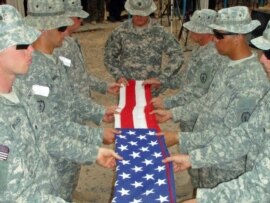
U.S. soldiers wrapped in the flag ceremony of the departure from a base in Iraq
30.10.2011
Nazim Yasin
Guest White House on Saturday the latest round of US-Iraqi talks, which were conducted at the level of national security advisers in both countries. It was reported that the talks, which came two months before the date of the withdrawal of all U.S. forces from Iraq focused on the "shared vision of a broad partnership and strategic depth" contained in the Strategic Framework Agreement between Baghdad and Washington. And discussed the Adviser to the President Barack Obama's National Security Advisor Tom Donilon with his Iraqi counterpart Faleh Al-Fayad "elements to establish a relationship of full normalization of relations between Iraq and the United States, including education, investment and security," according to a statement to the White House spokesman Jay Carney. The talks came after about ten days of Obama's speech in which he emphasized his firm resolve to complete U.S. military withdrawal on 31 December next, as stipulated in the Status of Forces Agreement (SOFA), signed in 2008. Obama announced in his speech during the meeting it was agreed by the cross (video conferencing) with Iraqi Prime Minister Nuri al-Maliki to form a joint coordinating committee, adding that he called al-Maliki to visit Washington. While emphasizing the U.S. commitment to the implementation of its commitments, he said that his country's relations after the withdrawal from Iraq would be the first day of next year, normal relations, as is the case of relations of two sovereign. In statements to the U.S. presidential spokesman Saturday, Carney pointed out that national security advisers discussed the results of the meeting Obama - Maliki, who held through (video conferencing) several hours before dumping the U.S. president a recent speech. The Tommy Vietor, spokesman for the National Security Council of the White House said on Friday that the chancellor, Donilon postponed a planned visit last week to China and India to remain in Washington to help Obama to address the situation in Libya and a decision on U.S. forces in Iraq. In the reading of a statement presidential spokesman the U.S. on talks, the White House at the level of national security advisers, expert considered the Iraqi security Amir Jabbar Saadi said the meeting was in preparation for the visit al-Maliki's visit to Washington in December I next. In this regard, told Radio Free Iraq, "it is noted that this meeting takes place under the node detail is very important, a process that the U.S. withdrawal from Iraq and the lack of political consensus inside Iraq to keep the trained or the number of combat troops ... have created an obstacle to the compatibility between the two countries, especially since Iraq is a signatory to the Convention on the framework of strategic cooperation a long-term with the U.S. ... so the meeting to attend the talks, Maliki Almertqah in Washington if the denominator for an implementing agreement can be signed formally between the Governments of the two countries away from the Iraqi parliament and Tnacfat political blocs ....". referred to synchronize the news of the White House meeting Saturday with the re-publishing the statements previously Chief of Staff of the Iraqi army team that Ba Baker Zebari said that Iraq will not be able to protect its borders and airspace before 2020 at least. According to the AFP news agency that the latest report by the U.S. Inspector General for Iraq Reconstruction quoted Zebari that "Iraq may be needed for several years before being able to defend itself against external threats, without the help of international partners." The report quoted Zebari to confirm the readiness of non-completion of the defense in the face of "any external aggressions before the date of between 2020 and 2024," explaining that "the decline in government funding of the most prominent reasons for the delay." He added that "Iraq will not be able to defend its airspace by 2020, at the earliest," pointing out that "an army without air cover is an army exposed," as he put it. and already Zebari that was announced in August last year that Iraqi forces will not be able to completely to take over the security file, before 2020, and will need to support the U.S. until then. But President Obama said in his recent speech that the United States has withdrawn since the announcement last year, "the termination of our combat mission in Iraq, and to date, more than 100 thousand soldiers with Iraqis took full responsibility for the security of their country." He said U.S. military officials recently that the number of U.S. troops remaining in Iraq amounted to 39 thousand are stationed in 15 bases. In his analysis of the significance of re-publishing the statements of the Chief of Staff of the Iraqi failure to ready defense by 2020, while the complete withdrawal of U.S. forces after the failed talks on keeping a part of these forces as trainers, Saadi told Radio Free Iraq in the interview I had with him over the phone Sunday afternoon Reminding the political street internal assessments of the highest commander of an Iraqi military that will lead to a stimulus "if there was a consensus Iraq - a new U.S. yield talks about national security advisers that there should be additional forces or training, giving some of the possibilities being with NATO forces will give some legal cover for its existence .... and thus the process of technical advice on the interpretation represented by the army chief of staff is to put pressure on Iraqi politicians inside .. as there are actual need for system security, especially the Iraqi army, the lack of readiness until the end of the year 2020, unless requires therefore some concessions from the party of the Iraqi political and according to the Strategic Framework Agreement, which includes one of its clauses security aspect ...". While continuing to complete the withdrawal of U.S. troops remaining in Iraq during the next two months, reported The New York Times Sunday that Washington plans to boost military presence in the Gulf on the back of fears that withdrawal would destabilize the region. The report, published under the title "The United States is planning to strengthen its presence in the Gulf after leaving Iraq," by Thom Shanker and Steven Lee Myers, Thom Shanker and Steven Lee Myers officials and diplomats that these possible plans could include repositioning forces new combat in Kuwait to enable it "to respond to the collapse of security in Iraq or a military confrontation with Iran." The report added that the plans under discussion for several months, gained a "new urgency" after Obama's announcement on 21 October that all American soldiers in Iraq, will return to the home by the end of the year. Although the decision to end the war in Iraq was one of the fundamental commitments during the Obama campaign but the military leaders and American diplomats, as well as officials from several countries in the region, are worried that the withdrawal may undermine regional stability or lead to something worse. After the failed efforts of the Obama administration and the Iraqi government to maintain a limited military in Iraq after 2011, the Pentagon paints an alternative plan. In addition to negotiating to maintain a combat ground in Kuwait, the United States is considering sending more warships to the Navy through international waters in the Gulf, in the words of the newspaper. The report added that in addition to Iran as a threat to fight the administration is also seeking to expand military ties with six countries in the GCC, namely Saudi Arabia, Kuwait, Bahrain, Qatar and United Arab Emirates and the Sultanate of Oman. While the United States has military relations and bilateral ties with each of these countries, the administration and the army are trying to strengthen what he described as "security architecture" new to the Gulf region would be integrated into air patrols and naval and missile defense. more details in the audio file, which includes an interview with security affairs expert Amir Jabbar Saadi.
http://www.iraqhurr.org/content/article/24376127.html

